



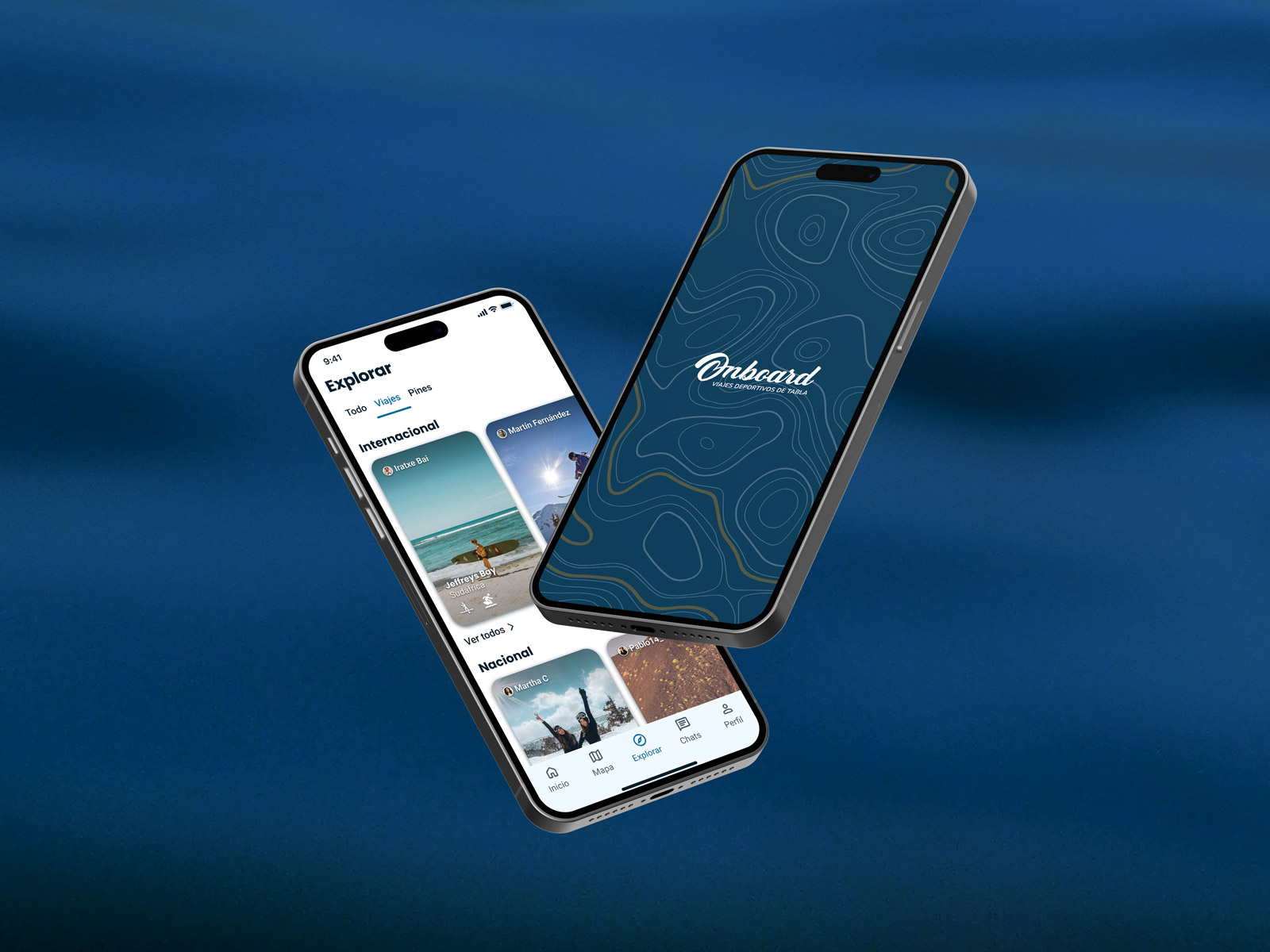
As part of my Master’s in UI/UX at Nuclio Digital School, I worked alongside Laia Garcia Cambero, Andrés Isiegas, Gabriel Martínez Cabrera, Sonia Alarcón Segarra, and María Lucía Artigas on a group project developed from October 2023 to April 2024. Using Figma, we created the prototype for a native iOS application called Onboard – Sports Travel for Board Riders.
Onboard is a community-driven tool designed to plan sports trips involving boards, enabling users to find destinations that match their personal preferences and offering a personalized and satisfying travel experience from planning to return. The app allows users to post and share pins and trips, enriching the platform with community-driven experiences and recommendations.
The project’s development went through several key phases: research, product strategy, UX design, UI design, and UX evaluation (user testing).
Onboard Preview – Figma Prototype

Generative UX Research
In this initial stage of the project, we introduced the chosen theme through the mind map process and presented our archetype Alex, along with their user persona and sports journey. Additionally, we explained how the interviews provided us with valuable insights and prepared a survey for validation.
Mind map

Problem definition
The problem we have chosen to address encompasses the entire planning and experience related to board sports travel, including activities such as surfing, windsurfing, wing foiling, kitesurfing, snowboarding, and wakeboarding.
Target audience
Our target audience consists of men and women aged 30 to 45, athletes of various skill levels (both amateur and professional), who participate in board sports and reside in Europe.
Desk research
We researched the market and selected a brief summary of the main competitors, based on the criteria that our potential users consider when planning their sports trips.

Interviews
To gather insights, we defined a study group and conducted interviews with potential users aged 30 to 45.


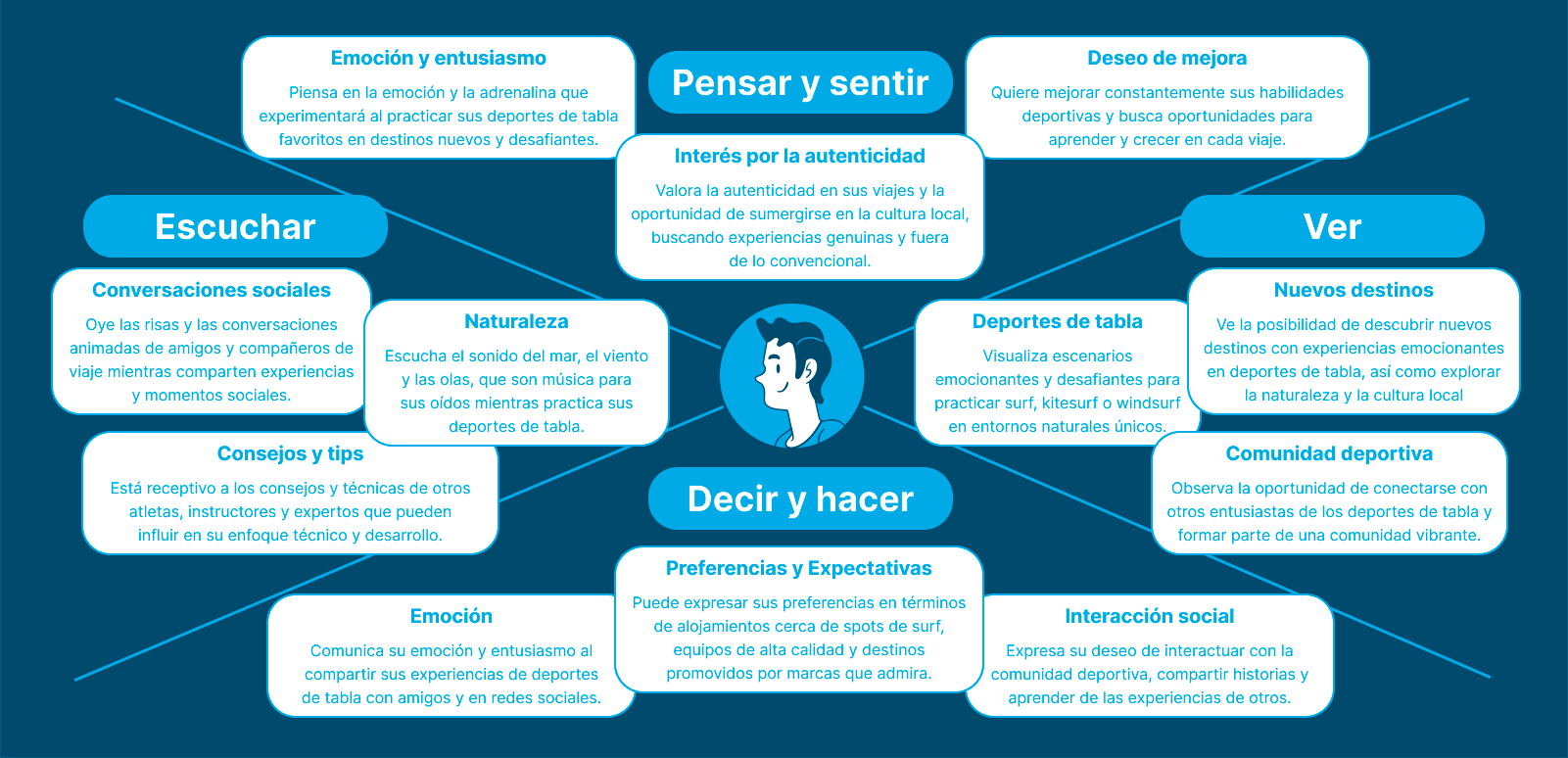
Empathy map
User persona


Customer journey map
Now that we know Alex, their personality, interests, goals, and frustrations, we present their experience in sports travel: how it begins, the phases they go through, and what happens when their adventure ends, and they return home.


Insights for validation
Thanks to the steps taken so far, we have been able to compile a list of potential insights pending validation:
- Alex encounters challenges in planning due to the lack of flexibility in dates and the need to coordinate with friends to organize trips.
- Concern about the safety and maintenance of equipment.
- Adaptability to different cultures and local norms.
- Frustrations due to adverse weather conditions that can affect sports plans.
- Alex values opportunities for improvement and learning during their sports trips.
- Alex values social interaction and sharing experiences with friends.
Product strategy
Surveys

Based on the survey results, we have drawn several conclusions:
- Frequency and Companionship: Nearly half of the respondents engage in board sports up to 5 times a year, preferring to do so in groups, although coordinating with friends is a challenge. Most do not choose foreign countries for their activities.
- Community and Tourism: Trusted recommendations are key for planning trips, highlighting the need for a community to exchange opinions and recommendations. There is a strong interest in local tourism and gastronomy.
- Social Media: More than half share content from their trips on social media. While they are interested in meeting new people, they tend to travel with the same group of friends, presenting an opportunity to facilitate new connections.
- Forecasting and Integrations: Users need to check the weather forecast for spots, so it would be useful to integrate weather apps or Windguru into our product.
Therefore, Alex prefers reliable feedback from someone close or experienced when deciding on a sports destination, optimizing costs and time. Alex needs a shared space to efficiently plan the trip with companions and requires information to adapt to the environment and make the most of the experience.
Brainstorming and Final Idea Clustering
Functionalities to implement that can address Alex’s needs:

User story mapping

Value proposition
Onboard helps plan board sports trips, allowing users to find destinations that match their personal preferences. This enables them to enjoy a personalized and satisfying experience from the planning stage through to their return.
Feature Prioritization Matrix

MVP – Basic features

Branding


UX Design
Sitemap

Task flow / User flow

Wireframes (low and mid-fidelity examples)


Prototype
User testing & feedback
Target
Hypotheses
- The user will associate the background image with the app’s environment (splash screen).
- The user will understand everything they can do in this app based on the onboarding process.
- The user will correctly understand the different options of each plan (free plan vs. premium).
- Rate the legibility of the app’s iconography from 1-10.
- The user finds the offered content inspiring without needing to register.
- The user intuitively knows how to navigate the map and its functionality.
- The user understands how to save and edit pins.
- The user knows how to navigate the home screen and, in addition to finding the widgets useful, understands the difference between the explore section and its suggested content.
- The user understands how to create, edit, delete, and archive trips.
- The user finds all sections of the trips useful and understands their purpose.
- The user understands how to set a route, modify or delete it, and its relationship with associated pins.
- The user finds the community section useful and practical for adding and contacting new connections.
- The user understands the different privacy settings for their posts and how to manage them.
- The user understands how to edit their profile and app settings.
- The user sees the support and contact section of our app as necessary.
Participants and comments


Iterations
After gathering user feedback, we made several iterations on the prototype, implementing and correcting various aspects of the product.
